You will never meet the patients better speech privacy would have saved. That is the problem. The patient who holds back a symptom does not tell you why. The one who skips the follow-up does not call to explain. Nothing shows up in a chart audit. The visit just quietly does less than it should have.
Picture one of them. A patient sits on the exam table and finally says the thing they came in to say. Then they walk out past the waiting room and notice that the person in the nearest chair went quiet a moment ago. Maybe they heard something. Maybe they did not. The patient will never be sure, and neither will you. Sometimes that is all it takes. The patient clams up, and an illness goes untreated.
The numbers say this is not rare. In a study of more than 4,500 adults, 60 to 80 percent admitted withholding medically relevant information from their clinicians. The leading reasons were not clinical. They were embarrassment and fear of judgment. And the patients in the poorest health were the most likely to hold back. None of that is fixable with a policy. Some of it is fixable with a ceiling.
That last part is not a metaphor. In a lot of medical offices, speech privacy in the exam room was never as reliable as the closed door made it seem. And the path speech took out of the room usually was not the door at all. It was the ceiling.
Speech privacy in an exam room is not a courtesy. It is a patient’s right.
What you will find below:
- What HIPAA actually says about spoken conversations, and what counts as an incidental disclosure
- Why a practice can pass a compliance audit and still leak conversations word for word
- HHS’s own answer on whether soundproofing is required, and the building codes that do set a number
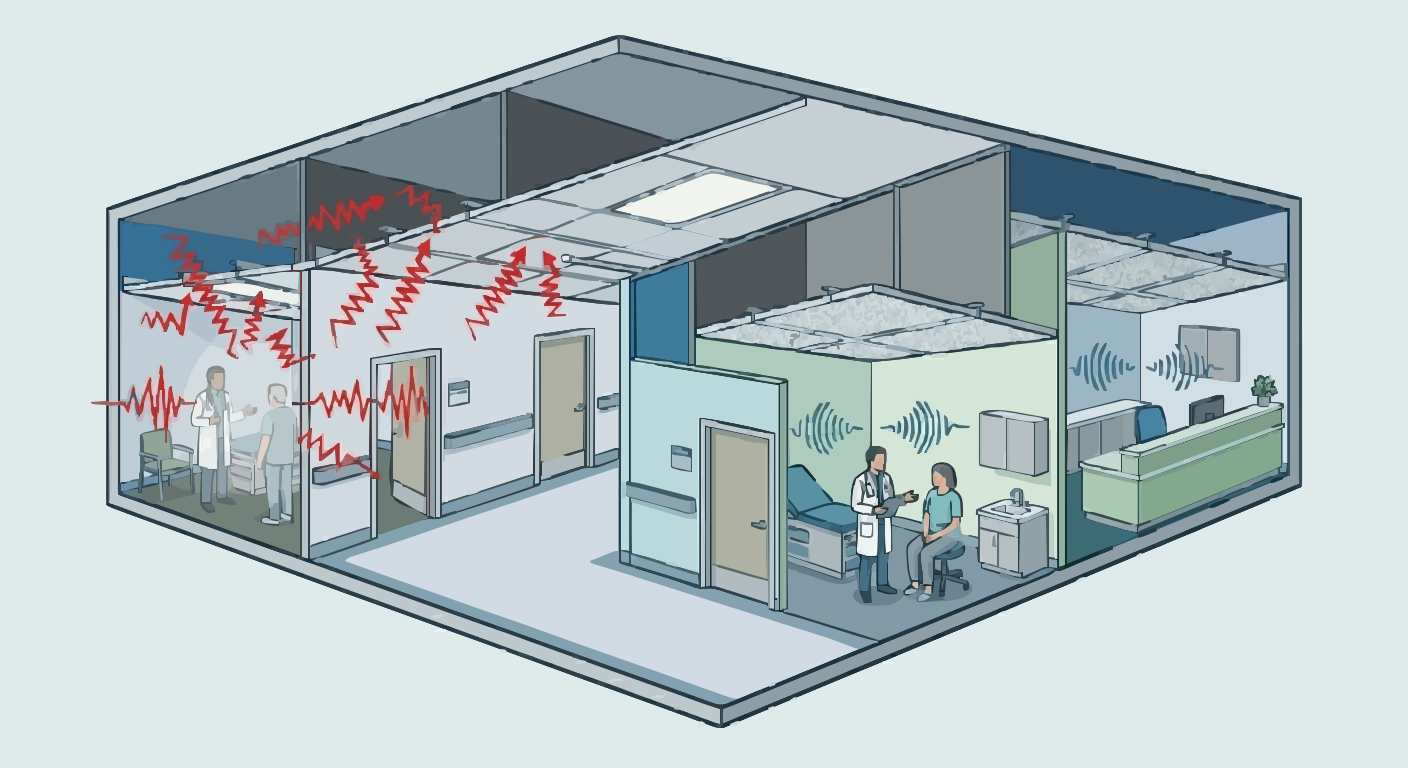
- The six paths speech takes out of an exam room, and why the ceiling beats the door
- Two numbers that explain the whole problem: a wall at STC 45, a ceiling tile at STC 5
- A five-minute walkthrough to test your own rooms, no equipment needed
- What a confidentiality-grade exam room requires, and what installs without construction
HIPAA Was Written for the Spoken Word, Too
Most practices think about HIPAA in terms of records: the EHR, the patient portal, encrypted email, the locked file room. All of that matters. But the Privacy Rule protects health information in every form it takes, including the spoken word. A conversation between a provider and a patient is protected the moment it contains identifiable health details, and it is entitled to the same protection as anything in the chart.
The rule is realistic about how a clinic works. Some overhearing is unavoidable. A name called in the waiting room, a quick word at the nurse station. The law calls these incidental disclosures, and it allows them, on one condition: the practice has to be taking reasonable steps to keep conversations private in the first place, and keeping what gets said out loud to what the care actually requires. Accidental overhearing is forgiven. Overhearing that happens because nothing was ever done about it is not.
That is where a leaky room stops being incidental. If a patient in the next exam room or the waiting area can follow the actual content of a conversation, word for word, the patient’s loss of privacy is no longer an unavoidable byproduct of care. It is a safeguard that is not doing its job.
The Overheard Diagnosis Problem
Overhearing another patient’s diagnosis is damaging on more levels than most people realize, and most of the damage only shows up once the cat is already out of the bag.
Walk the corridor of a typical medical office, urgent care, or specialty clinic during a busy afternoon and listen. Even behind closed doors, voices carry, and in a clinical setting the words that carry are not always pleasant, and they are unusually specific. Names. Dates of birth. Medication names and dosages. Diagnoses. Test results. The exact information the law is built to protect.
Several things make medical spaces especially vulnerable:
- Exam rooms are stacked in tight rows. Clinics are laid out for throughput, with similar rooms lining a shared corridor under one continuous ceiling. The wall between two rooms may be solid, but the space above the ceiling is not.
- The conversation is identifiable by design. Clinical care requires saying specific things out loud, often more than once, and often at raised volume when a patient is hard of hearing, anxious, or in pain.
- Most spaces were never purpose-built for speech privacy. Practices frequently move into former retail or general office space and inherit suspended ceilings and partition walls that were never designed for clinical confidentiality.
The result is a category of privacy failure that does not show up in a records audit or a risk assessment spreadsheet, but is obvious to anyone standing in the hallway.
Why “HIPAA Compliant” on Paper Does Not Mean Speech Privacy in the Room
HIPAA never says how private a room has to be. There is no sound rating to hit and no construction detail to follow anywhere in the rule. So a practice can check every box, signed agreements, encrypted systems, trained staff, locked cabinets, and still have a space above the drop tile ceiling that carries voices into the neighboring rooms.
HHS has actually answered this question directly. Asked whether the Privacy Rule requires offices to be retrofitted with private rooms and soundproof walls, the answer was no. Nobody has to soundproof anything under HIPAA. What every practice does have to do is weigh known privacy risks against the cost of fixing them, because that is how HHS says reasonable gets decided. That math looked one way when fixing a room meant demolition. It looks different when the fix installs above the existing ceiling tile in an afternoon.
That does not mean nobody has written down a number. The design rules for healthcare buildings have. The Facility Guidelines Institute’s design and construction guidelines, which most states have adopted into their healthcare facility licensing rules, set sound isolation targets for clinical spaces. The bar between exam rooms is STC 50 for rooms relying on construction alone. The people who plan hospitals and clinics decided long ago that an exam room conversation deserves a wall that blocks sound, and they put a number on it. For scale, a standard ceiling tile comes in around STC 5.
Here is the catch. Those rules apply when a healthcare facility is designed, built, or renovated. A practice that moved into space built as ordinary offices was never held to them, and neither was the ceiling it inherited. The building codes assume the walls go where the sound goes. In most leased medical space, the walls stop at the ceiling grid, and the sound goes over the top.
From a practical standpoint, an organization that becomes aware of an acoustic privacy problem and leaves it unaddressed has a harder time arguing that its safeguards are still reasonable. The Office for Civil Rights tends to weigh safeguards against what the entity knew and what was feasible to fix. Once a leak has been identified, the standard for what counts as reasonable can change quickly.
There is also a dimension that never reaches a regulator. Patients who suspect they can be overheard hold back. They leave out the detail that would have changed the visit, or they decide not to schedule the follow-up at all. A room that fails at privacy does not just create legal exposure. It gets in the way of care.
Where the Sound Actually Goes
Most medical offices are built the same way as the rest of the commercial market: suspended drop tile ceilings, with partition walls that stop at the ceiling grid rather than the deck above. The space between the drop ceiling and the deck is called the plenum, and it is where speech privacy is lost or won.
Below the ceiling line, the walls do a great job of stopping speech. That is the elephant in the room: the walls stop at the ceiling line. Above the tiles there is no wall, just one wide open space running from one end of the building to the other, and the ceiling components in between can’t stop spoken words. A sheetrock wall typically carries an STC rating around 45. A standard ceiling tile carries an STC around 5. You get the picture. (STC is the standard measure of how well a barrier blocks sound. Higher is better.)
Speech leaves an exam room through a handful of predictable paths:
- Up through the ceiling tiles into the shared plenum, where it reflects off the deck above and comes right back down into the neighboring rooms. Ceiling tiles absorb some sound, but a significant amount of speech passes straight through the tile into the plenum, and from there it is off and running to every room that shares the ceiling.
- Through the light fixtures. Recessed fixtures have openings, and their rigid housings are good transmitters of speech, carrying it up into the plenum speech highway. A standard ceiling assembly is more a visual barrier than an acoustic one.
- Across the rigid components, which act as bridges. Light fixtures, the grid, and HVAC housings literally carry the vibration of speech through the ceiling plane and into the plenum.
- Through open air return grilles. Some rooms use 2 x 2 open grilles, the egg crate style, which are wide open to the plenum. Speech goes straight up, reflects off the deck, and comes down in the neighboring rooms.
- Along supply ductwork, especially when runs for different rooms connect above the ceiling.
- Under and around the door, where undercuts and gaps let speech straight into the corridor or waiting area.
This is why a practice can renovate, repaint, and refurnish its exam rooms and still have the same privacy problem afterward. None of those upgrades touch the actual pathways. For a fuller look at how the overhead space behaves, see our breakdown of why sound leaks through ceilings, and for why acoustic panels alone rarely fix it, sound blocking versus sound absorption.
What a Confidentiality-Grade Exam Room Sounds Like
Effective speech privacy in a clinical space is layered. No single product solves it, because the sound is using more than one path. The pieces that tend to matter most:
- Block the plenum. Adding mass behind the ceiling tiles with a dense ceiling tile backer keeps speech from rising into the shared overhead space. In most exam-room retrofits this is the single highest-impact change.
- Treat the light fixtures. Acoustic light hoods enclose the back of recessed lights so they stop acting as openings in the ceiling.
- Silence the air returns. Plenum return silencers let air flow normally while breaking the direct sound corridor between rooms.
- Treat the supply ductwork. Air feed hoods on the diffusers keep voices from carrying through the supply path.
- Absorb inside the room. Fabric-wrapped acoustic wall panels reduce reverberation, which lowers the natural tendency of voices to rise and makes the room feel calmer. People tend to speak more quietly in a room that already sounds quiet.
- Address the door. A solid-core door with proper seals and a bottom sweep closes one of the most common direct paths into the corridor.
Together, these measures produce what acousticians call confidential speech privacy: the level at which a person in the next room cannot make out the words being spoken, even when they try. That is a meaningfully higher bar than the casual privacy standard commercial construction delivers, and it is the right target for any room where health information is discussed out loud. The Speech Guard System delivers it as a complete, code-compliant ceiling overlay, installed as a retrofit without demolition. The difference is night and day, and staff feel it fast: the treated rooms become the ones everyone wants to use. Our office isolation case study shows the before-and-after measurements from a real facility that closed those pathways.
A Five-Minute Speech Privacy Walkthrough for Practice Managers
You do not need a sound meter or a consultant to find out where you stand. A short walkthrough tells you most of what you need to know:
- Stand in the waiting area while two staff members hold a normal conversation in an exam room with the door closed. If you can make out words, your patients can too.
- Repeat the test from inside the adjacent exam room. The room-to-room path is often worse than the room-to-corridor path because of the shared ceiling above.
- Look up. Note where recessed lights, return grilles, and supply diffusers sit relative to the walls between rooms. Anything crossing or sitting near a demising wall is a likely path.
- Ask your staff. Front desk and clinical teams almost always know which rooms feel private and which do not. Some have already adapted by lowering their voices or steering sensitive visits to specific rooms.
That last one is an efficiency problem hiding in plain sight. When only some rooms can be trusted with a sensitive conversation, scheduling bends around the building. Make every room private and every room goes back into the rotation, which is how speech privacy improves office efficiency along with the care.
Speech Privacy Is Part of the Care
A medical practice can do everything right on paper, encrypt every record and sign every agreement, and still have a building that gives the quiet part away. Speech privacy is one of the few HIPAA safeguards a patient can actually perceive from the waiting room chair, and it shapes how much they are willing to tell you once the door closes. Patients like and trust a doctor more when their words stay in the room, and that trust is what stronger patient relationships and better outcomes are built on.
It is invisible when it works and corrosive when it does not. For a space where people are asked to share the most sensitive facts of their lives, making sure those words stay in the room is a reasonable place to spend part of the budget.
Do the right thing and provide speech privacy in your examination rooms.
Wondering whether your exam rooms are acoustically private? Speech Guard works with medical, dental, and behavioral health practices to pinpoint the specific pathways carrying speech between rooms and close them with targeted, retrofit-friendly products. Reach out for a no-pressure walkthrough. See the Speech Guard System, or get in touch.