Acoustic ceiling tile backer: installs above the tiles you already have

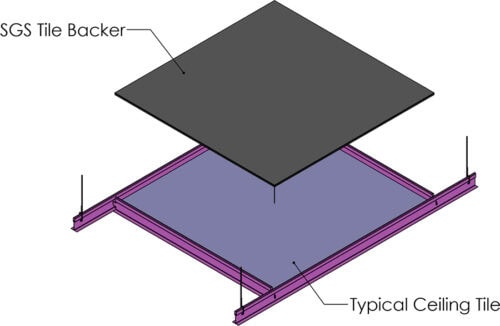
The Shield Guard Tile Backer lays on top of the acoustical ceiling tiles in a standard ceiling grid. Your tiles and grid stay exactly where they are. The backer adds mass above them, so less conversation passes up through the tile into the shared plenum and back down into the room next door.
Day and Night Difference from your current noise level.
Send your room dimensions, plenum height, ceiling grid size, lighting fixture counts and return grille counts. We return a system layout and a quote at no charge.
What the tile backer is not
It is not a replacement ceiling tile. You are not buying tiles. The backer sits above the tiles you already own, and they stay in the grid.
It is not a decorative acoustic panel. Panels absorb sound inside a room and make it quieter to sit in. The backer blocks sound from leaving a room through the ceiling. Those are two different jobs.
It is not electronic sound masking. There is no power, no speakers and no noise generator. Nothing is added to the room that you can hear. More on masking versus blocking.
Sizes and specifications
- 24″ x 24″ (610 x 610 mm), item #2212
- 24″ x 48″ (610 x 1220 mm), item #2214
- Core available 1/8″ and 1/16″ thick
- 1.1 pounds per square foot. A 24″ x 48″ panel weighs 8.8 pounds.
- Specification section CSI 09 51 13, Ceiling Accessory
Installation
- Installed on top of acoustic tile in suspended ceiling tile systems
- No mounting clips or adhesive required
- The white non woven face goes down, toward the tile
- Border pieces are cut to size on a flat surface with a carpentry knife and a straight edge, then handed up to the installer
- Keep the gap between a cut edge and the grid or the wall as small as you can
- At sprinkler penetrations, mark the opening with a circle cutter and keep the gap around the pipe to a minimum
Test data
Sound transmission. The barrier material was tested to ASTM E90-09 and classified to E413-10 at STC 27. Riverbank Acoustical Laboratories, report RAL-TL14-387. This figure is for the barrier material tested on its own, not for a ceiling assembly.
The current production drawings for items #2212 and #2214 carry the same STC 27 under the heading Sound Blocking Performance, resolved by frequency in decibels. This is the same rating stated above, not a second test.
| 125 Hz | 250 Hz | 500 Hz | 1000 Hz | 2000 Hz | 4000 Hz | STC |
|---|---|---|---|---|---|---|
| 17 | 18 | 22 | 28 | 33 | 39 | 27 |
In a ceiling assembly. The figures above describe the barrier material on its own, which is not how anyone buys it. A suspended ceiling fitted with Shield Guard Tile Backers over all tiles and four Speech Guard Light Hoods over the recessed fixtures was rated Ceiling Attenuation Class 38, to ASTM E1414-16 and E413-16. NGC Testing Services, report NGC6020011, tested October 15, 2020. Ceiling Attenuation Class measures sound travelling from one room up through the ceiling, over the wall through the shared plenum, and down into the room next door. That rating is for the tile backers and light hoods together, not for the tile backer on its own.
Surface burning. Class A flammability rating per ASTM E84. A USG Radar R2310 ceiling tile backed with Shield Guard returned a Flame Spread Index of 10 and a Smoke Developed Index of 5, against Class A thresholds of 25 and 450. HPVA Laboratories, report T-14132.